TL;DR
A second brain is an external system for capturing, organising, and retrieving the knowledge you accumulate through your work and life.
It exists outside your head, typically in a digital tool, so that you don't have to rely on memory alone to retain what you've learned. The second brain concept was popularised by Tiago Forte and has become one of the most widely adopted approaches to personal knowledge management (PKM). The idea is sound: your brain is better at having ideas than storing them, so offload the storage to a trusted system. Where current second brain tools fall short is in how they capture knowledge. Nearly all of them require you to manually write, clip, tag, and organise everything yourself. That means the quality of your second brain depends entirely on how much time you have to maintain it and what you happen to remember to put in.
The Second Brain Concept
Everyone has experienced the frustration of knowing they learned something but not being able to recall it. The name of the company a prospect mentioned. The framework from a book you read six months ago. The decision your team made in a meeting that nobody wrote down. The insight that felt important at the time but faded by the end of the day.
A second brain is the solution to this problem. It's a personal system, usually digital, where you store the things you learn so they're available when you need them. Instead of relying on your biological memory, which is unreliable, limited, and prone to decay, you externalise your knowledge into a system that remembers everything and forgets nothing.
The scale of the problem makes the case on its own. According to research from the University of California San Diego, the average person receives roughly 34 gigabytes of information per day, the equivalent of about 105,000 words reaching their eyes and ears during waking hours. Our senses gather data at a rate of a billion bits per second, yet conscious thought operates at roughly 10 bits per second (Zheng & Meister, Neuron, 2024). We are taking in vastly more than we can ever consciously hold. And the volume is increasing by about 5% per year.
The term was popularised by Tiago Forte, whose book "Building a Second Brain" has sold over 500,000 copies and been translated into more than 25 languages. His methodology, built around a four-step process called CODE (Capture, Organise, Distil, Express), gave people a practical framework for turning the information they consume into a structured, searchable, reusable body of knowledge.
But the idea itself is much older. Commonplace books, a practice dating back centuries, served the same purpose: a personal notebook where people recorded quotes, observations, ideas, and references for later use. What's changed is the medium (digital tools instead of leather-bound notebooks) and the volume (we now encounter more information in a day than previous generations did in a week).
How a Second Brain Works
Most second brain systems follow a similar pattern, regardless of the tool. The core workflow is sometimes called the CODE method (Capture, Organise, Distil, Express), though the underlying steps apply whether or not you use Forte's specific framework.
You capture information as you encounter it. A quote from an article. Notes from a meeting. A screenshot of something useful. An idea that occurred to you in the shower. The goal is to get things out of your head and into the system quickly, before they fade.
You organise what you've captured so you can find it later. The most common organisational framework is Forte's PARA method, which sorts everything into four buckets: Projects (active work with a deadline), Areas (ongoing responsibilities), Resources (topics of interest), and Archive (completed or inactive items). Others use tags, links, folders, or graph-based approaches where notes connect to each other through relationships rather than hierarchy.
You distil what you've captured into something useful. Raw notes and highlights aren't knowledge. Distilling means summarising, condensing, and reformulating what you've saved so that your future self can use it without re-reading everything. The goal is to make each note useful in under 30 seconds.
You express what you know by using it. Writing, presenting, making decisions, building something. This is the step that turns passive collection into active knowledge. A second brain that's never drawn from is just a filing cabinet.
Best Second Brain Tools and Apps
The second brain concept is tool-agnostic, but certain tools have become closely associated with it.
Obsidian uses local Markdown files with bidirectional links and a graph view that shows connections between notes. It appeals to people who want full control over their data and deep customisation through plugins. It's powerful but demands more setup and maintenance than most alternatives.
Notion combines notes, databases, wikis, and project management in a single flexible workspace. It's the most popular choice for people who want their second brain to also handle tasks, projects, and collaboration. Its flexibility is both its strength and its weakness: you can build anything, which means you have to build everything.
Roam Research pioneered bidirectional linking and daily notes in a way that resonated with researchers and writers. It treats knowledge as a network rather than a hierarchy, which maps well to how ideas actually connect.
Apple Notes, Google Keep, and OneNote serve as simpler starting points for people who don't want to learn a new system. They lack the linking and organisational depth of dedicated PKM tools but have the advantage of zero setup.
Mem takes a different approach by using AI to help organise notes, reducing some of the manual sorting that other tools require. It represents an early step toward reducing maintenance overhead, though it still depends on the user to capture knowledge in the first place.
Soda goes further. Rather than asking you to capture and organise knowledge manually, Soda runs quietly in the background and captures knowledge from the work you're already doing: calls, conversations, browsing, screen activity. It represents a fundamentally different model, one where the second brain builds itself from your actual work rather than requiring you to build it on top of your work.
Each tool sits at a different point on the spectrum from manual to ambient. The more a tool depends on you to capture and organise, the more time it demands and the more knowledge slips through. The less it depends on you, the more complete the picture becomes.
Why Second Brains Matter
The case for building a second brain rests on a few observations that are hard to argue with.
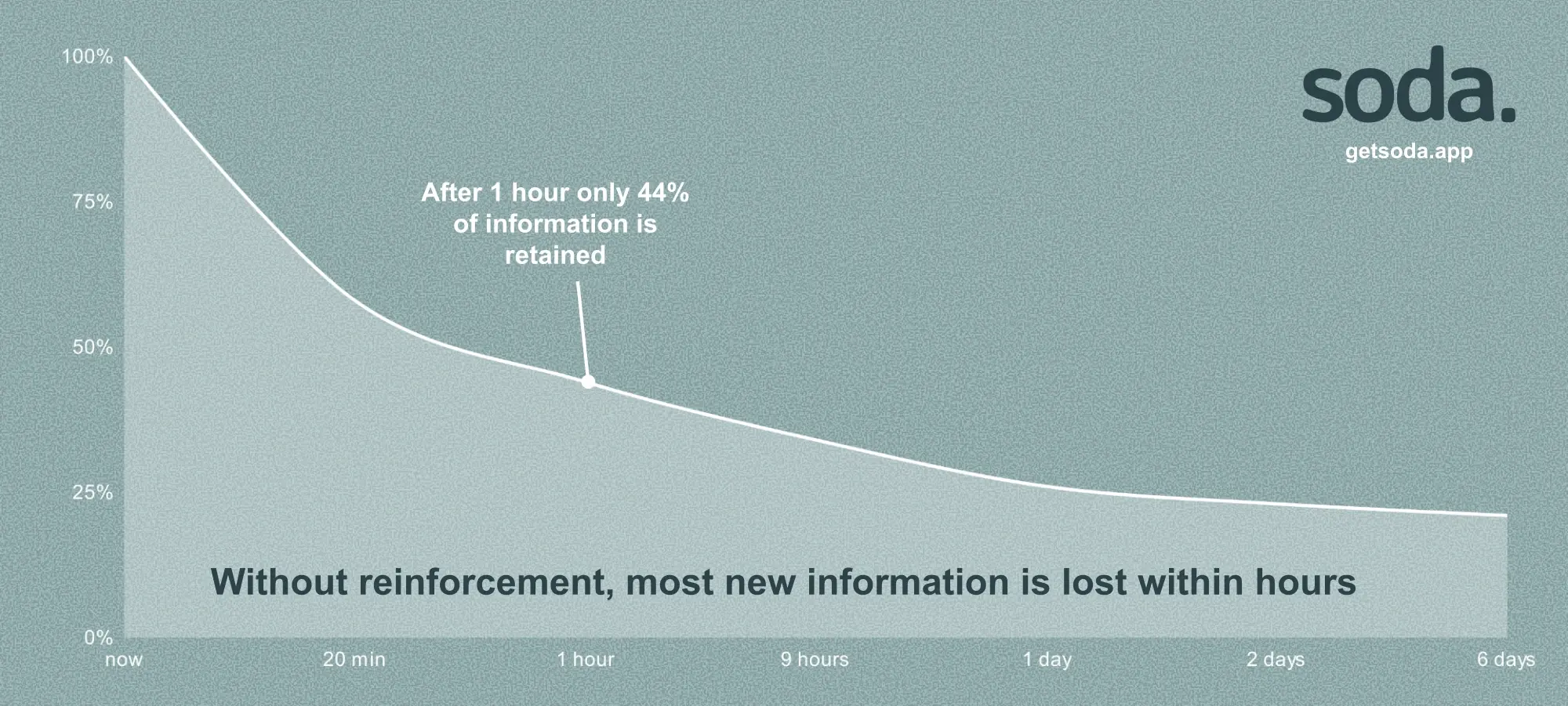
Human memory is unreliable. We forget most of what we learn within days. The Ebbinghaus forgetting curve shows that we lose roughly 50% of new information within an hour of learning it, and up to 70% within 24 hours. Short-term memory can hold about 7 pieces of information at once, for approximately 20 seconds. Your brain has a storage capacity of roughly 2.5 million gigabytes, but the bottleneck was never storage. It's retrieval. A system that captures knowledge externally protects it from this decay and makes it findable when it matters.
The volume of information we encounter is increasing. The average person now processes the equivalent of 34 gigabytes of data per day, up from the equivalent of about 7 gigabytes in 1986. That's a five-fold increase in less than 40 years, and the curve is still climbing. More meetings, more messages, more content, more tools, more context-switching. The gap between what we take in and what we retain is widening every year. A second brain helps close that gap.
Knowledge compounds. An idea captured today might not be useful for months. But when the right moment arrives, having it available, searchable, and connected to related ideas creates an advantage that's impossible to replicate from memory alone.
Creative work depends on connections. The most valuable insights often come from combining ideas across domains. A second brain that stores knowledge from different areas of your life makes these cross-domain connections visible in a way that biological memory rarely does.
Why Second Brain Systems Fail
The concept is powerful. The execution, for most people, is not.
The fundamental limitation of every mainstream second brain tool is that it depends entirely on manual input. You have to stop what you're doing, open the tool, and deliberately capture what you've learned. Every piece of knowledge that makes it into your second brain got there because you had the time, the presence of mind, and the discipline to put it there. Everything else is lost.
This creates three problems that compound over time.
The capture gap. You can only capture what you remember to capture. In a day filled with calls, meetings, browsing, and conversations, the vast majority of what you learn never makes it into any system. Your second brain contains what you had time to write down, which is a fraction of what you actually know.
The maintenance burden. Creating a note is easy. Keeping it accurate is the real work. Knowledge is temporal: pricing changes, people move roles, strategies shift, decisions get reversed. A note written three months ago might be actively misleading today. Every second brain accumulates knowledge debt, the gap between what the system says and what's actually true. Keeping the system current requires ongoing effort that most people can't sustain. This is the part that breaks most second brains: not the initial capture, but the maintenance that follows.
The personal silo. Traditional second brains are personal by design. What you capture is available to you and only you. In a professional context, this means the knowledge your colleague captured from a client call, the context your manager gathered from a board meeting, the detail your teammate noticed on a competitor's website, none of it flows to anyone else. The organisation doesn't benefit. The knowledge stays locked in individual systems that walk out the door when people leave.
The Future of the Second Brain
The next generation of second brains will look fundamentally different from today's tools.
The shift is from active to ambient. Instead of requiring you to capture knowledge manually, future second brains will capture it passively from the work you're already doing: calls, conversations, browsing, screen activity. The concept of ambient knowledge capture removes the person from the capture process entirely. You don't have to do anything differently. The knowledge just gets captured.
The shift is from static to living. Instead of documents that decay the moment they're written, future second brains will update continuously as new information emerges. Knowledge becomes temporal and self-correcting rather than a snapshot frozen at the moment someone last had time to edit it.
The shift is from personal to shared. Instead of individual note systems, future second brains will make knowledge organisational by default. What one person learns becomes available to the whole team. The second brain becomes a shared knowledge layer that compounds across people, not just within one person's system.
The shift is from storage to action. Instead of a library you visit when you have a question, future second brains will surface relevant knowledge proactively based on what you're doing. Preparing for a call? The context from every previous interaction appears. Researching a company? What your colleagues have learned about them shows up. The knowledge comes to you, rather than you going to it.
The insight behind the second brain, that your brain is for having ideas, not storing them, remains as true as ever. What's changing is who does the work of building it.