You're two minutes from a call. You know you've spoken to this person before. You know they mentioned something about budget pressure, or maybe it was a team restructure. You're pretty sure they had concerns about onboarding. But you can't place any of it. So you jump on the call and hope it comes back to you mid-conversation.
That gap between what you've learned about someone and what you can actually access when it matters is one of the most expensive problems in customer-facing work. And until today, even Soda couldn't fully close it.
Soda has always captured what happened. Your calls, your browser, your screen. All of it stored, searchable, ready when you needed it. But knowing what was said on a call is different from knowing what you actually know about a person. One is a transcript. The other is understanding.
That's what just changed. And you don't have to do anything to make it work. No setup, no configuration, no fields to fill in. Soda learns about people the same way it learns everything else: by paying attention while you do your job.
AI contact profiles that build themselves
Soda now builds a living profile of every person you interact with. Not a paragraph summary that goes stale after two weeks. Not a wall of transcript you'd have to scrub through before your next call. Specific, structured facts about who they are, what they care about, and how your relationship has evolved.
Jane mentioned pricing concerns in March. She changed roles in April. Her company relocated to Portland. She's evaluating three vendors and she's worried about onboarding timelines. Her CFO is the real decision-maker but she's the one driving the evaluation internally.
These aren't notes you wrote. They're things Soda picked up because it was there, learning alongside you. And now instead of being buried inside transcripts and summaries you'd never re-read, each of those details is something Soda can surface the moment you need it.
The difference feels small until you experience it. Before, you'd ask Soda "what was discussed on the call with Jane last month?" and get an answer. Now, you ask "what do I know about Jane?" and get a picture. Her role, her concerns, her company, the history of every interaction, all in one place and all kept current. Zero clicks. Zero data entry. Zero configuration.
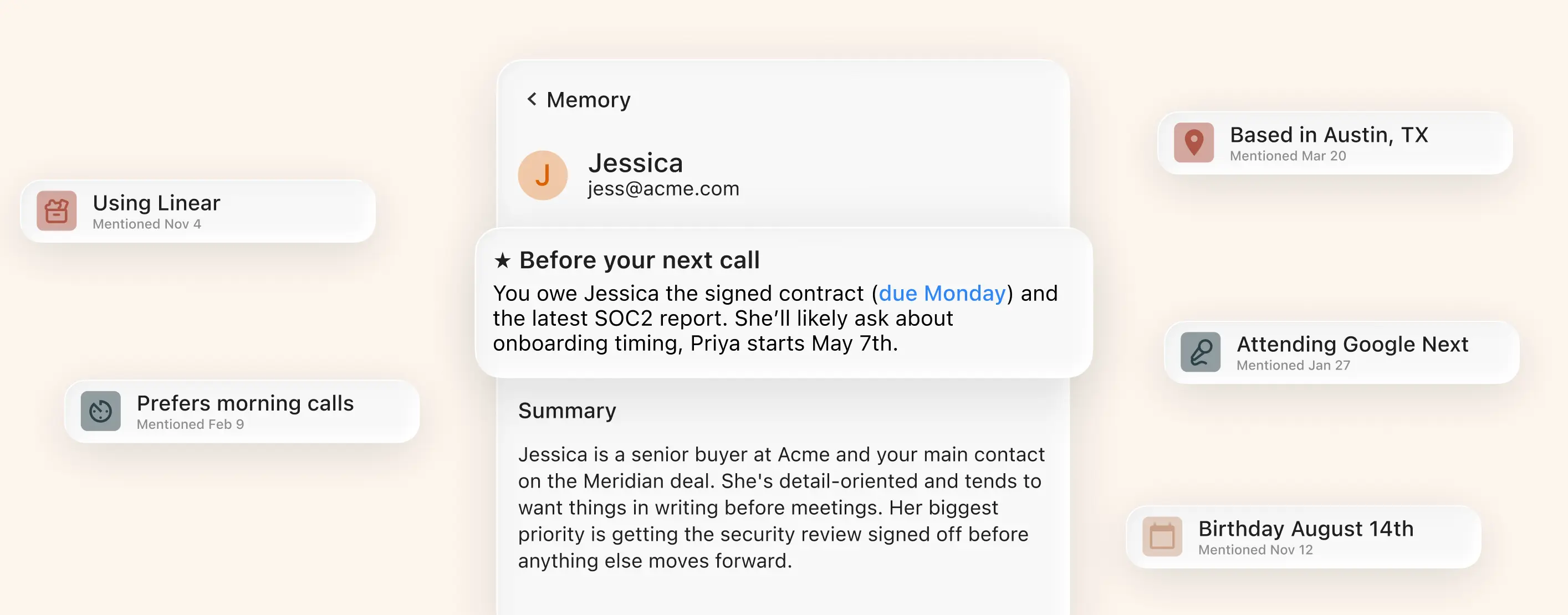
Every fact traced to its source
There's a reason most people don't trust AI-generated summaries in professional contexts. You're about to walk into a real conversation with a real person based on information a machine gave you. If it's wrong, you look like you weren't paying attention. Which is worse than not having the information at all.
Every fact in a Soda contact profile traces back to the exact moment and the exact words that produced it. One click and you see why Soda believes what it believes. Not a confidence score. Not a vague "based on your recent activity" hand-wave. The actual quote, from the actual interaction.
Contact history that stays current
People change jobs. Priorities shift. A concern that was urgent in January gets resolved by March. The way most tools handle this is they don't. You get a static summary that drifts further from reality every week, unless someone manually updates it. And nobody does, because nobody has time, which is the whole reason the information wasn't captured properly in the first place.
When something changes about a contact, Soda updates what it knows and keeps the history. Jane's previous role doesn't disappear. It moves to her history. You can see where she was, where she is now, and how the relationship has evolved across every conversation you've had. The kind of knowledge that usually lives in people's heads and nowhere else, except now it doesn't.
Relationship intelligence that compounds
This is where it gets interesting and where Soda starts doing something that would be genuinely impossible to replicate manually. Every interaction you have makes these profiles richer. Not because you're logging anything or updating any fields. Just because you're doing your job and Soda is learning alongside you.
Three months in, you have a depth of knowledge about your contacts that no CRM field could hold and no human could maintain across 30 or 40 accounts. Six months in, you're walking into every conversation with context that makes people say "I can't believe you remembered." You didn't remember. But you don't need to tell them that.
Your CRM organises deals. Soda fills them with what actually happened. And now, what Soda knows about the people behind those deals just got a lot deeper.