

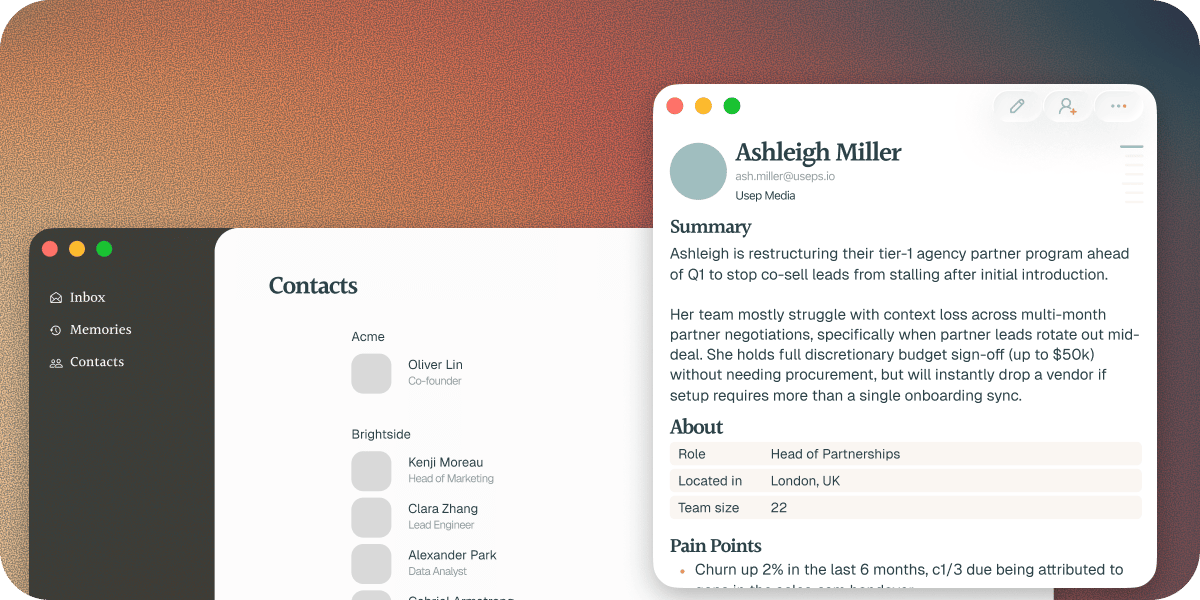
What Soda keeps
Soda’s memory has three parts, and each one links to the others.People and companies
A living profile for everyone you talk to, and for every company they work at.
Details
What Soda has learned about each of them, from a job title, to a birthday, to a concern raised.
Memories
The calls and email conversations those details came from.
What Soda pays attention to
Soda listens for far more than names and job titles. It follows the whole conversation and looks out for dozens of kinds of detail: someone’s role and who they report to, the decisions they’ve made, what’s worrying them, the products they use, who they compete with, their partners, their projects, their hobbies and interests, and plenty more. It even spots an out-of-office reply, and notes when the person is back. It keeps track of commitments too, and who’s responsible. “Send over the security documents” is something you owe Jessica. “Get sign-off from finance” is something she owes you. Knowing what to leave out matters too. Small talk doesn’t make it in. A vague plan doesn’t either.The personal side
Relationships are built on the personal details, so Soda looks for those on purpose: family, birthdays, what someone gets up to outside work, where they’re based, and how they like to be contacted. Soda picks these up even when they come up in passing, in the last minute of a call or the last line of an email. Jessica mentioned her daughter’s graduation as the call was wrapping up. It was a throwaway line, but Soda kept it. So before the next call, you know to ask how the celebrations went, and Jessica feels like she’s talking to someone who was listening and who genuinely cares. A personality takes more than one meeting to judge, and Soda knows it. One friendly email doesn’t make someone warm, and one tense call doesn’t make them difficult. When Soda has only a single passing comment to go on, the profile says so.Soda checks its own work
After every conversation, Soda reads back over each detail it picked up and checks it against what was actually said. If the words don’t back a detail up, it’s dropped. And a point that came up three times in slightly different words shows up once. That second look happens before anything reaches a profile, so what you read there reflects what people really said.Shaped by the relationship and the meeting
Every profile is unique and shaped by the nuances of that given relationship. You’ll see Soda paying attention to very different things if the conversation is a 121, an interview, or a board meeting. A sales discovery call leads with the customer’s pain points, their budget, and the next steps. In a one-to-one with your manager, feedback and how you’re developing come first. A technical catch-up puts the blockers and decisions up front. Relationships change, and profiles follow. When the sceptic on the buying committee becomes your biggest champion, their profile says so.It knows who a detail is about
Soda knows who said what, and who it’s about. A worry belongs to whoever raised it. When Jessica says the rollout timeline worries her, that goes on Jessica’s profile, even though the timeline is Halden’s. When someone talks about a person who isn’t on the call, Soda files the detail under that person. Say Jessica mentions that her boss, Bruce, has moved to the Berlin office. That lands on Bruce’s profile, and Bruce is linked to Jessica, even though he’s never been on a call with you. Over time, Soda build out and maps out who knows who inside an account, including people you haven’t even met yet. Two people with the same name stay two people. If you know a Priya at Halden and another at Acme, Soda tells them apart by where they work and who they’re connected to.Shared Company Brain
Memory is private by detault, not even visible to account admins. What’s shared is controlled by you
A company profile
What we know about a company rarely comes from one person. Someone in their finance team mentions a re-org to sales. A week later, someone in operations mentions that year-end targets are putting their team under pressure. Neither conversation tells the whole story on its own. When the company is shared across your team, both points land on its company profile. Open it, and they sit together in a short summary of where the business stands.Profiles are automatically updated
Say a customer mentions they’ve moved to a new company. Nobody updates anything. The next time you open their profile, it already shows the new role and the new company. Their old role isn’t lost. It moves into their history, with the date it changed. Soda shows you what’s changed, too. Recent changes are highlighted on the profile, and a +N new badge counts what’s arrived since you last looked.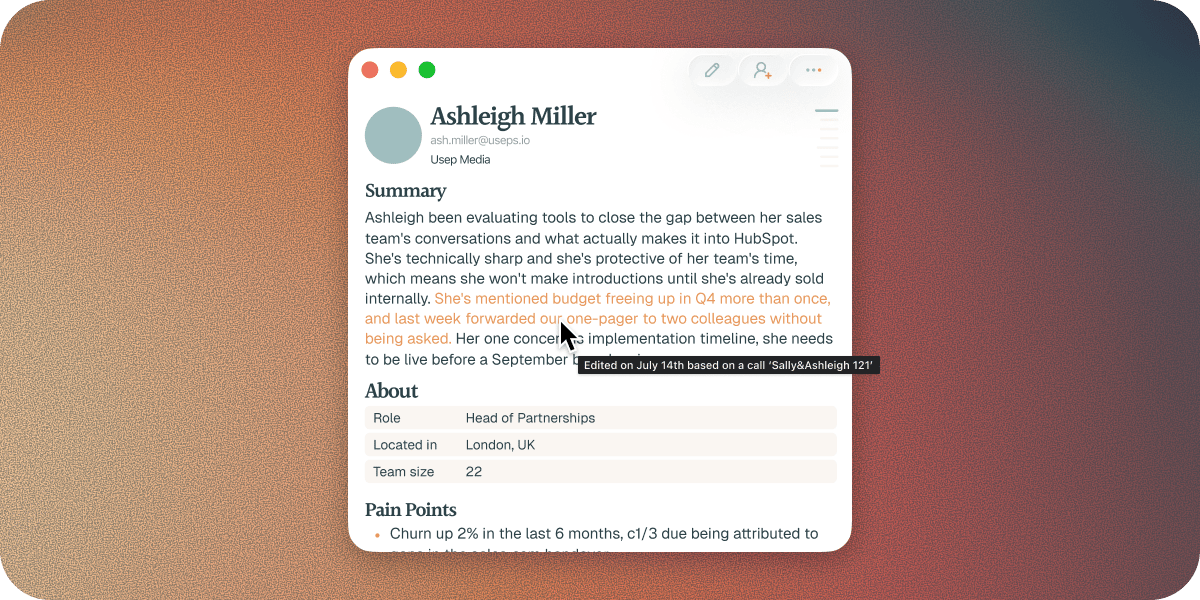
Tracing memory to source
Trust is important and you never have to take Soda’s word for anything. Right-click any detail on a profile to see where it came from: the call or email, the exact words, and the date. Click through to open the conversation itself. Below that is the detail’s history, with every earlier value and when it changed. See how to check a detail’s history.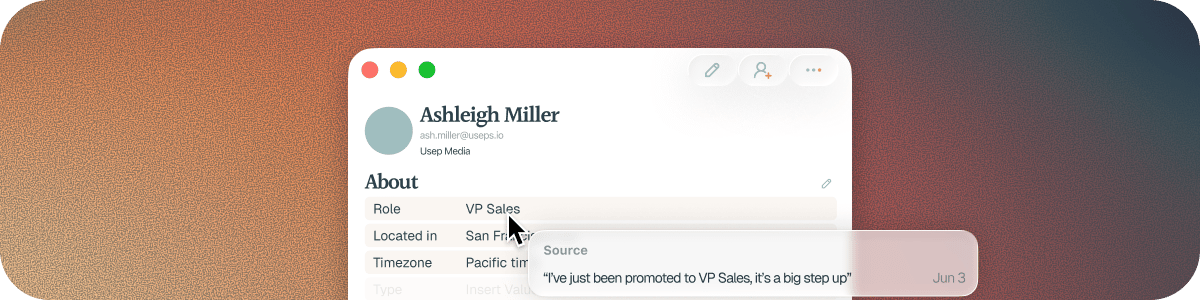
Backfilling memory
Soda learns from every interaction. The more you work with someone, the more it knows about them. See which conversations become memories. But you don’t start from scratch, either. The first mailbox you connect backfills the last 30 days of conversations, up to 600 of them. Any mailbox you connect after that is kept in sync from the moment you add it.You stay in control
- Soda never keeps the audio from your calls. See what Soda captures, and what it never does.
- Type over a detail that’s wrong, and your version wins. A later call won’t change it back. See when Soda gets it wrong.
- Delete a memory you’d rather not keep. See your memories.
- Exclude people or whole domains, like your lawyer or your accountant, and Soda stops learning about them. See how to exclude people and domains.
Next steps
How profiles stay up to date
What happens when someone changes jobs, and how Soda shows you.
Your memories
Find any call or email conversation, and keep on top of what you owe.